


The Culture of the Wilusans
The politics and religion of Wilusa might appear on treaties and royal archives, but the day to day reality of the people of Wilusa is often silent in such records, particularly given that any archives that may have been stored in the WIlusan Royal Palace were destroyed during the initial excavations by Heinrich Schliemann between 1870 -1873.
Subsequent excavations have uncovered more of the site and its environs, allowing us a much deeper understanding of the lives of the people who lived in Wilusa, whether they inhabited the splendours of the walled citadel or the sprawl of the Lower City, enclosed only by a wooden stockade and an anti-chariot ditch.


Who were the Wilusans?
We have spoken about the Luwian Kingdoms and people in an earlier page, however the greek-derived name of one of their Kings, Alaksandu (top left) rather begs the question as to whether Wilusa was inhabited by Luwians, Greeks or a mixture of both. Taken in combination with the only written evidence from the period in Wilusa being a seal in the Luwian language (top right) the latter might appear to be a reasonable conclusion.
This needs to be considered alongside the fact that neither of the other Wilusan Kings' names that occur in the Hittite archives, Kukkunni and Walmu appear to be Greek derived. Even when we extend our examinations to the Iliad we find the Trojan royal family contains members with apparently Luwian derived names - Paris (Pari-ziti) and Priam (Priya-muwa) as well as Greek ones such as Hector or Kassandra.
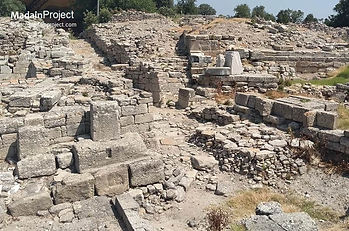
The remains of the city itself are similarly ambiguous. The overall layout of the Citadel and Lower city resemble that of Hattusas as do the walls that surround the citadel. However the houses within the citadel are Mycenaean style megaron halls, whilst the bulk of the pottery remains in the Lower City are culturally Anatolian (centre). This mix of cultures within Wilusa can be interpreted many different ways, but in The Wilusiad I have chosen the model of an overwhelmingly Luwian population and culture, combined with a recently established Mycenaean Greek descended royal family.



What did Wilusa look like?
The city I use as a model for The Wilusiad's city of Wilusa is the layer known to archaeology as Troy VI, which is also the layer that best matches the description of Troy provided by Homer in The Iliad. This city was divided into two sections, the Citadel at the crest of the hill to the North and the Lower City stretching down the southern slopes of the hill (top left).
The citadel was enclosed by vast walls similar to those that enclosed the Hittite capital at Hattusa (top right), which protected it from external enemies and separated it from the Lower City, whose inhabitants could enter it only via the South Gate (centre). This Lower City was home to the majority of the population and was protected by a wooden stockade surrounded by a ditch which appears to have been designed specifically to repel attacks from chariots.
The houses themselves were box-like in design (bottom left), with a central hearth and a hole cut into the roof above it to let the smoke out. Houses in the lower city usually consisted of two floors and a flat roof which could also be used as living space, depending on the weather.
Whilst the arrangement of dwellings in the lower city was somewhat sprawling, in the citadel itself they were arranged in a series of concentric rings. rising to the Palace at the apex of the Hill.
These citadel dwellings would also appear somewhat box-like from the outside, although often including a pillared porch at the front. Their interiors strongly resembled Mycenaean Megaron halls (Below right), although uniquely they do not have windows on the ground floor. Why this should be has be is a matter of considerable speculation, but the evidence does not currently allow us a firm answer to that question, although I add a suggestion of my own to The Wilusiad.




What did Wilusans Eat and Drink?
In order to survive any human settlement needs a reliable water source, which Wilusa had in abundance in the shape of cold water springs the bubbled up under the city. These springs were revered, indeed their spirits are evoked as witnesses to the Alaksandu treaty (above) and managed carefully by the city's inhabitants. A series of artificial caves and tunnels, originally built centuries before the events of the Trojan War funnelled this water to the city's inhabitants (top left). In addition to water, imported amphorae of Mycenaean wine suggest that it was frequently drunk by the elites, probably watered down. In the Palace and other elite households guests may well have been welcomed with wine served in a rhyton, such as the stunning Hittite example in the top right.
Evidence from the midden pits discovered around the ruins of Wilusa we know that deer like that depicted on the rhyton in the top right played a significant part in the diet of the elite members of society, along with meat from domestic animals such as sheep and cows, which also seem to have provided cheese.
For the bulk of the inhabitants of Wilusa however such meat would have been an occasional luxury, it is was accessible at all. From what we can tell they ate locally caught fish such as tuna (bottom right), combined with locally grown vegetables. Cereals such as wheat and corn would have formed the basis of most people's diets and hand querns to grind them into flour are found in many houses in Wilusa. We have also found pithoi, large jars (bottom left) containing the remains of cereals built into the floors of some houses as storage containers, particularly in the event of war or sieges.


What did Wilusans Wear?
The abundance of spindle whorls and loom weights used for weaving found throughout the ruins of ancient Troy make it clear that weaving cloth was an important part of the life and prosperity of the people of Wilusa. These are found throughout the site, both in the Lower City and the Citadel. The fact that some of these loom weights are very small (top left) would indicate that in addition to large swathes of plain cloth, intricate work on small looms was also underway, probably to produce intricate borders for clothing, such as that we see on the clothes of Anatolian captives in Ancient Egypt at this time (top right).
The fabric on these looms would have been either wool from the sheep raised on the gentle hills surrounding Wilusa or linen produced from the reeds growing along the banks of the Skamander River which flowed nearby. Vegetable and mineral dyes could be produced from local materials for the majority of the population. For the elite however, more exotic dyes could be produced using saffron and murex snails (middle Left) to produce the famous purple dye of later eras (indeed murex shells have been found in the remains of the city). The elite may also have been able to wear garments made of sea silk, a material produced from fibres harvested from the Mediterranean Giant Clam ((Pinna nobilis) (middle right).
In addition to rich clothing, jewellery was an important indicator of status in the ancient world. As can be seen from the two examples below, both found in the ruins of a Troy ii, a city dating from 2500BC, the Wilusa of the Trojan War was already heir to a tradition of gold working that dated back over a thousand years.


