


Religion in The Wilusiad
Creating religious beliefs and practises from over 3000 years ago was one of the most exciting and challenging aspects of building the world of the WIlusiad. With limited written sources to assist regarding Wilusan/Trojan religion I relied very much on archaeology and information we had about the religious practices of their better documented neighbours such as the Hittite Empire to create a plausible spiritual life for Wilusa.



What deities did the Wilusans worship?
The clay tablet on the left is the Alaksandu Treaty, currently in the Troy Museum in Turkiye, which was found in the archives of the Hittite capital of Hattusas.
Whilst the terms of the treaty itself are not without interest in the development of The Wilusiad but from the perspective of WIlusan religion its interest lies in the Deities called upon to witness it, including the deities of Wilusa. These include the deities of the underground springs and Appaliunas, widely interpreted as an early Anatolian iteration of Apollo. This is interesting as Apollo was the protector of Troy in the Illiad, and was also the God who the legendary Kassandra of Troy served and was ultiumately cursed by.
This connection between the written record and the Homeric legend, to say nothing of the mysterious deities of the underground springs was a great starting point in developing a distinctive religion for The Wilusiad.


The Alaksandu Treaty - Image By Dosseman - Own work, CC BY-SA 4.0,
Where did the Wilusans Worship?
Recognising specific temples from the remains of Troy VI, which is the city I use as Wilusa has proved difficult since so much of the central city, where such temples would be, was destroyed during the first excavations at Hisarlik by Heinrich Schlieman in the 19th Century.
For this reason when reconstructing the Holy Places of Wilusa I drew from what is known about the Holy Sites of the surrounding cultures, including the surrounding Luwian cultures and that of the Hittites. In the Hittite capital of Hattusas for example, the upper city contains many sites which appear religious in nature, most notably the location in the top photograph, complete with the mysterious green stone in the centre.
In addition to this they frequently worshipped in underground grottos and sacred springs since such places were believed to be the entrances to the Underworld. The site at Eflaton Pinar (centre) is a wonderful surviving example. At the bottom is the famous rock cut temple set in the mountains above Hattusas, which was probably used for spring festivals designed to entice the exiled gods back to the city every year. All these gave be plenty to work with when creating the varied sacred sites in Wilusa

The Hattusa Green Stone and surrounding temple. Photo: Paul Williams / Alamy Stock Photo
Hittite Sacred Spring at Eflatun Pnar. Photo by Noumenon - Own work, CC BY-SA 3.0,


Chaber B of Yaazilikaya rock temple. Photo by Bernard Gagnon - Own work, CC BY-SA 3.0,
What did the Wilusan Deities look like?
We have several clues as to what Wilusans and their neighbours believed their gods looked like, both in the form of rock cut images and amulets that have been discovered over the years.
Most spectacular are the images cut into the rock faces of the temple of Yazilikaya, such as the one at the top here, showing a God with the conical crown meeting a Goddess wearing the cylindrical crown. In addition, we have amulets that would have been worn for protection about the neck, that give us beautiful details about the figured revered in Late Bronze Age Anatolia, such as those in the middle section.
For those interested in Wilusa however the little idol in the bottom of this section is the most evocative by far, as it was excavated from the ruins of Troy VI, which is the city I have used as the basis for Wilusa. Although impossible to confirm it is hard not to speculate that this idol may be the face of Appaliunas himself.


Who worshipped the Wilusan Deities?
Most City and State Gods in Anatolia and the Ancient Near East were worshipped first and foremost by the King and Queen themselves. This can be seen in the iconic carving from Chamber B of the Yazilikaya where the Hittite King Tudhalija IV is shown wearing the robes of a priest and being embraced by the God Scharruma (top right). His mother, Queen Pudahepa, was referred to by the title "Mother of the Gods", as were most of her predecessors (top left). These depictions gave me a great start when devising the robes and appearance of the many religious figures that appear in the Wilusiad.
Beneath the royal couple themselves Hittite archives refer to a shadowy figure called the Sister of the God. It is not clear who this figure is, other than that she is a member of the royal family and is second only to the |Mother of the Gods herself in religious celebrations and even merits her own chariot at such events. Exactly what this figure's role is is a matter of some debate and appears to vary depending upon the city and political situation. Sometimes for example the woman is described as living in the temple, sometimes in the Palace, but it appears she had access to independent wealth as a result of her title. For the purposes of The WIlusiad I have interpreted this figure as being somewhat similar to that of other royal women throughout the Ancient Near East and Egypt whose lives were dedicated to the Gods rather than as diplomatic brides.
These women, such as the Royal Wives of Amun in Egypt or the High Priestesses of S'in in Sumer, of which Enheduanna, Daughter of Sargon of Akkad (middle picture) is the most famous example. Putting Kassanda of Wilusa into this tradition gave me a whole new perspective of her as a character and propelled the story of the WIlusiad forward.
Most priests and priestesses in a temple would not have been royals, however they would likely have been recruited from elite or at least well to do families, such as the one I have envisaged for the priest Laiku inThe Wilusiad. Examples of these non-royal priests and priestesses of the various Anatolian deities can be seen in the bottom picture.

Tudhalija IV in priestly robes, photo by Klaus-Peter Simon - Own work, CC BY 3.0,
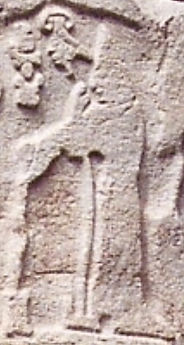
Queen Pudahepa, photo by : Klaus-Peter Simonderivative work: Zunkir (talk) - Firaktin2Kayseri.jpg, CC BY 3.0,
.jpg)
