Warfare in the Wilusiad
Given that The Wilusiad is a novel about the Fall of Troy it would seem remiss not to discuss the way warfare would have been conducted in the Late Bronze Age Aegean. Since both the Mycenaean and Hittite civilisations placed great store in military valour we have a wealth of both archaeological and written evidence about how it was conducted, quite apart from the battle scenes vividly described in the epic cycle.


Armour
While both side of the Trojan war would have worn armour, particularly their military elites, the styles they used differed greatly, sharing only a determination to display the power and wealth of their owners as much as to protect them on the battlefield. The evidence for how they looked however typically comes from two separate sources, archaeological remains of the actual armour and depictions of soldiers wearing it on rock carvings and vases from the time.
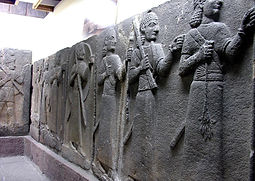
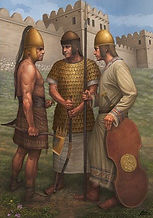
In the case of the Anatolian Wilusans, depictions of culturally similar Hittite show soldiers wearing wither ankle or knee length cuirasses (top left and centre) and conical helmets. These are complemented by archaeological finds of bronze scales, suggesting that these cuirasses were constructed of leather backed bronze scales in a similar manner to the stunning example found in Tuht Ankh Amun's tomb (top right). These cuirasses would have been flexible and light weight, but provide limited protection from stabbing weapons such as spears or sword points. In addition, the conical bronze helmet in the centre left picture gives us a final reconstruction of Anatolian warriors that resembles the reconstruction on the centre right.
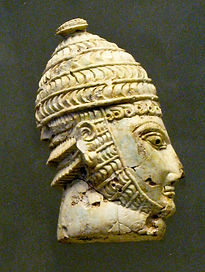
Looking across the Aegean Sea we find similar sources of evidence, although in the case of Mycenaean Greeks a lot of the pictoral evidence comes from decorative vases and votive statuettes rather than rock cut temples (centre right and bottom left). This shows soldiers with knee length armour and elaborate helmets that match well with the Dendera panoply (bottom centre), a stunning set of armour recovered from an elite grave. This iconic suit of armour (arguably the oldest complete set found in Europe) shows that, in contrast with the lighter, more flexible scale armour worn by Anatolian aristocrats, the Mycenaean warrior elites wore heavier plate armour capable of deflecting blows even when struck directly. Although the helmets that protected their heads were leather lined, the boars tusks that covered them ensured that these two would offer protection when struck.


.jpg)



.jpg)


Weaponry
One of the more fascinating recent finds at Hisarlik have been the discovery of arrow heads and sling stones stors within the walls of Troy Vi (top row), suggesting military activity within this layer, particularly considering the arrow heads were of the three dimensional type often used for war, as opposed to flat hunting arrowheads.
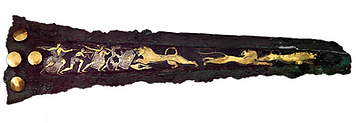
In addition to these comparatively humble ranged weapons, swords and daggers were often objects of high status, partly due to the inherent value of their bronze blades. They are often made with highly decorated hilts or scabbard, such as the iconic lion hunt dagger found by Heinrich Schlieman in Mycenae (centre). Most of these swords or daggers had thin or leaf shaped blades for thrusting attacks that could pierce armour, such as the thin Type A sword (bottom left), or the leaf shaped Naue ii blade (botom centre), the later being the blade most likely used by both sides during any historic Trojan War.
Bronze was a valuable commodity in the Mediterranean bronze age due to the rarity of local tin deposits, resulting in large quantities having to be imported from Cornwall in South West England. As a result weapons like axes and spears, that only use bronze for their heads were also commonly used throughout the Mediterranean. Whilst spearheads tended to mimic the leaf shape of the equivalent swords, axe heads came in a wide variety of shapes, such as the crescent and double headed examples on the bottom right.


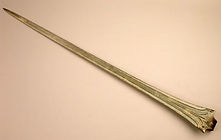


Mycenaean Sword found at Hattusa - this sword was presented to the Hittite gods following the suppression of the Arzawa uprising.

Chariots and Siege Warfare
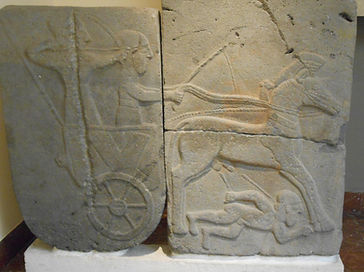
As I mentioned in the page about trade one of WIlusa's major exports appears to have been horses, a detail also noted in Homer's Illiad. Although there is sporadic evidence of people riding on horse's backs in the Eastern Mediterranean during this period, horseback cavalry does not appear to have used as a military corps as yet. Instead chariots were widely used, by both Anatolian and Mycenaean Greek forces as can be seen in the contemporary depictions in the top row. How these chariots were used is disputed, Homer depicts chariots as essentially "battle taxis" that heroes use to travel to the battlefield before dismounting and fighting on foot. Whilst there is evidence for this tactic during the early iron age, in the late bronze age the evidence currently suggests that chariots would act as mobile weapons platforms for the spearmen and archers inside them.
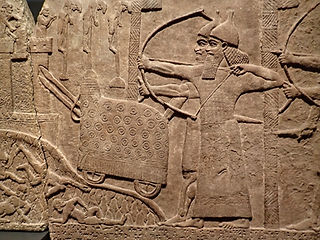
Siege weapons from this period are much harder to find evidence for, although basics ones such as ladders and battering rams almost certainly existed, as can be seen in this rock carving including a ladder in the bottom left. Siege towers and engines are well attested in the era that followed the end bronze age collapse, in particular in the hands of the Assyrians (bottom right), however evidence of them in the late bronze age is highly contentious. It has even been suggested that the Trojan horse itself is a garbled memory of an early siege engine, although this is not an interpretation of events that I chose to include in The Wilusiad.